High Ground, High Risk: Why Elevation Is No Shield Against Radon in Nevada Homes
There is a persistent assumption among Nevada homeowners that living at higher elevations provides some inherent protection against radon gas. The logic sounds reasonable on the surface: radon is a heavy gas that accumulates in low-lying areas, so a home perched on a hillside or nestled in the mountains must surely be safer than one sitting on the valley floor. It is an intuitive conclusion — and it is largely wrong.
Geological surveys and radon testing data collected across Nevada tell a more complicated story, one that every homeowner at every altitude should take seriously. Elevation alone is not a reliable predictor of radon risk. The factors that actually govern radon accumulation are far more nuanced, and dismissing the threat based on a property's height above sea level can carry genuine health consequences.
Where Radon Actually Comes From
To understand why elevation is irrelevant, it helps to revisit the source of radon itself. Radon is a naturally occurring radioactive gas produced by the decay of uranium and radium within soil and rock. It has no color, no odor, and no taste. As it migrates upward through the ground, it can enter structures through foundation cracks, construction joints, gaps around service pipes, and even porous concrete blocks.
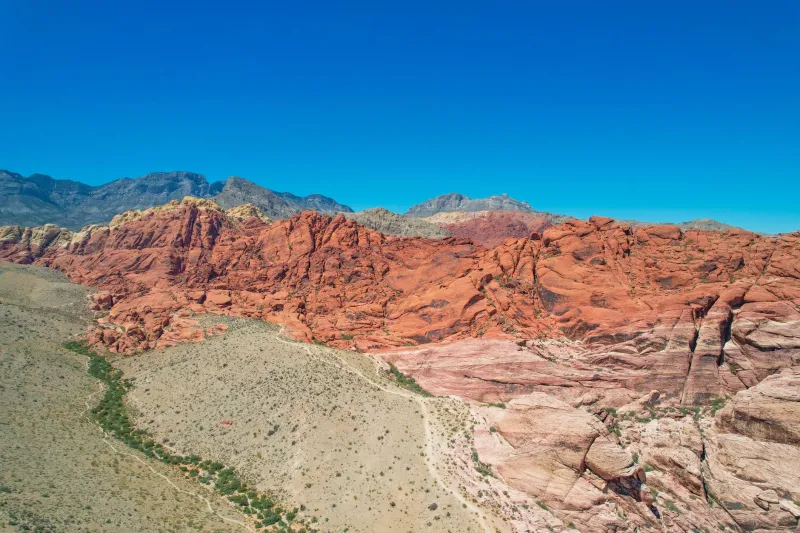
The critical variable is not how high the ground is — it is what the ground is made of. Nevada sits atop some of the most geologically complex terrain in the United States. The state's Basin and Range topography has produced a landscape where uranium-bearing granite, mineralized fault zones, and phosphate-rich sedimentary deposits appear at virtually every elevation. A mountainside home built on fractured granite can face radon concentrations just as elevated — sometimes more so — than a ranch house on the valley floor below it.
The Geology Beneath Nevada's Mountain Communities
Granite is among the most radon-productive rock types known to geologists. It contains relatively high concentrations of uranium, which decays steadily into radium and then into radon gas. Much of Nevada's mountain terrain, particularly along the ranges that define the state's characteristic corrugated landscape, is underlain by granitic intrusions and heavily mineralized metamorphic rock.
Communities situated in or near these ranges — including parts of Washoe County, portions of the Spring Mountains near Las Vegas, and the elevated terrain around Ely and Elko — sit directly atop geology that is highly capable of generating radon. Fault lines, which are abundant throughout Nevada due to its tectonic history, act as natural conduits that allow radon to travel significant distances through the subsurface before reaching a home's foundation.
In short, the same dramatic landscape that makes Nevada visually stunning is also responsible for distributing radon-generating geology across a wide range of elevations.
How Soil Permeability Changes the Equation
Beyond rock composition, soil permeability plays a decisive role in how readily radon migrates toward a home. Coarse, granular soils — common on hillsides and mountain slopes where erosion has deposited gravel and rocky debris — allow gas to move with relatively little resistance. This means radon produced deep in the ground can travel upward quickly, reaching a home's foundation before it has a chance to disperse.
By contrast, dense clay soils, which are more typical of certain valley floors, can actually slow radon migration. This counterintuitive reality means that some valley-floor homes built on clay-rich soils may accumulate less radon than hillside properties on porous, rocky ground — even if the valley-floor geology contains comparable uranium concentrations.
Homeowners on sloped terrain should also be aware that differential pressure plays a role. Homes on hillsides often experience variable soil pressure against different sections of their foundation, which can create pathways for radon entry that are difficult to anticipate without professional testing.
Why Building Construction Matters More Than Location
A home's construction type and foundation design are among the most significant factors determining how much radon enters the living space. Slab-on-grade foundations, crawl spaces, and basement configurations each present different opportunities for radon infiltration — and none of these construction styles is exclusive to any particular elevation.
Many Nevada mountain and foothill communities feature older homes with stone or masonry foundations, crawl spaces built into sloped terrain, or additions constructed at different times with varying levels of sealing. These features can create multiple entry points for radon regardless of how high the home sits. A tightly sealed modern home on the valley floor may actually have lower indoor radon levels than a drafty older home at 5,000 feet, simply because construction quality and sealing practices vary so widely.
The Danger of Elevation-Based Complacency
The most significant hazard posed by the elevation myth is not the misconception itself — it is the complacency that follows from it. Nevada homeowners who believe their hilltop or mountain location protects them are less likely to test for radon, less likely to act on elevated results, and more likely to go years without knowing that the air inside their home carries a measurable lung cancer risk.
The U.S. Environmental Protection Agency recommends that all homes below the third floor be tested for radon, regardless of location, construction type, or regional geography. The EPA's action level of 4 picocuries per liter (pCi/L) applies universally — it does not carry an elevation exemption.
Nevada's own radon data reflects this reality. Elevated radon readings have been documented in communities across the state's varied topography, from the low desert communities of Clark County to the elevated terrain of northern and central Nevada. No county, no elevation band, and no geological zone is categorically safe.
What Nevada Homeowners at Any Elevation Should Do
The most reliable way to determine your home's actual radon level is to test it. Long-term radon test kits, which measure average concentrations over 90 days or more, provide the most accurate picture of your home's risk. Short-term kits are useful for initial screening but should be followed by longer-term testing when results approach or exceed the EPA action level.
For homes that return elevated results, radon mitigation systems — typically sub-slab depressurization systems installed by certified contractors — are highly effective at reducing indoor radon concentrations. These systems work by creating a pressure differential that draws radon away from the foundation before it can enter the living space.
Homeowners in Nevada's mountain and foothill communities should not interpret their elevation as a substitute for testing. The geological forces that produce radon operate beneath the surface, indifferent to the altitude reading on a topographic map.
The Bottom Line
Elevation is a geographic fact, not a health guarantee. The geology beneath Nevada's varied terrain — its granite ranges, mineralized fault zones, and permeable hillside soils — produces radon at altitudes both high and low. Assuming that a mountain address confers protection is a myth that radon data has repeatedly disproven.
Testing remains the only way to know what is actually happening inside your home. For Nevada homeowners at every elevation, that simple step is the most important one they can take.