How Your Nevada Home's HVAC System May Be Spreading Radon From Room to Room
For many Nevada homeowners, radon is synonymous with the lowest level of the house — the basement slab, the crawlspace, the foundation. That association is not wrong. Radon does enter structures through soil contact points at the lowest elevations. What that mental model misses, however, is what happens next. Once radon infiltrates a home, your heating, ventilation, and air conditioning system can become an unwitting distribution network, pulling radon-laden air from concentrated source areas and pushing it into bedrooms, living rooms, and kitchens where your family spends most of its time.
This is not a rare edge case. It is a structural reality in a large share of Nevada homes, and it deserves serious attention from any homeowner who has tested elevated radon levels — or who has not yet tested at all.
Understanding How Radon Enters the HVAC Equation
Radon is a naturally occurring radioactive gas produced by the decay of uranium present in Nevada's soil and rock formations. It seeps upward through foundation cracks, construction joints, utility penetrations, and porous concrete. In a home without a functioning HVAC system running, radon tends to accumulate at its entry point and rise slowly through natural convection.
The moment you introduce a forced-air system, that slow drift becomes an active transport problem. HVAC systems operate on pressure differentials. When a system pulls air through return vents to condition it, it creates negative pressure zones throughout the home. If those return vents are located in or near a basement, crawlspace, or utility room where radon concentrations are highest, the system is essentially vacuuming radon-rich air and preparing to redistribute it.
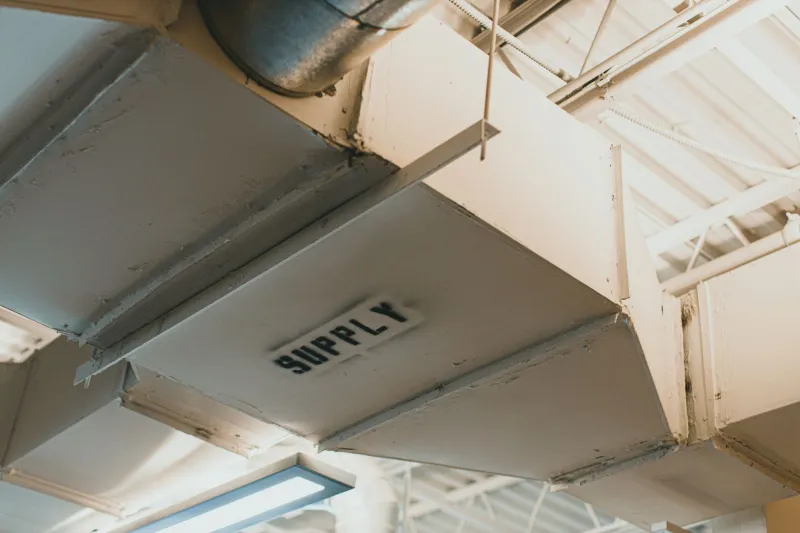
The conditioned air then travels through supply ducts and exits through registers on upper floors and in main living areas. What started as a localized problem in a below-grade space becomes a whole-home exposure concern.
Why Unsealed Return Air Systems Are a Particular Problem in Nevada
Nevada's desert climate encourages tight home construction for energy efficiency, but it also creates conditions where unsealed return air pathways become especially hazardous. In many Nevada homes built before the 1990s — and in some more recent construction — return air ducts were not sealed at every joint and penetration. In a dry climate where materials contract and expand with dramatic temperature swings, gaps in ductwork can widen over time.
Return air chases — vertical shafts used to route return air from lower floors to the air handler — are a particularly significant vulnerability. When these chases are not properly sealed from adjacent spaces, they can draw air directly from crawlspaces or wall cavities that communicate with the soil. The HVAC system never "knows" the difference between conditioned indoor air and radon-bearing air seeping in from an unsealed chase. It treats all of it the same: something to circulate.
This means that even a home with a relatively modest radon reading in the basement could register concerning levels in an upstairs bedroom if the HVAC return system is pulling from below-grade spaces.
Identifying the Warning Signs in Your Own System
You do not need an engineering degree to identify whether your HVAC system may be contributing to radon distribution. There are several observable indicators worth examining.
Return vent locations matter. If your home has return air registers located in a basement, mechanical room, or near a crawlspace access point, those locations warrant scrutiny. Return vents in these areas pull air from radon-prone zones first.
Duct condition is a meaningful signal. Visible gaps, disconnected sections, or corrosion around duct joints in unconditioned spaces suggest that the system is drawing in unconditioned — and potentially radon-bearing — air from outside the intended envelope.
Pressure testing reveals hidden pathways. A qualified HVAC technician or radon mitigation specialist can perform a blower door test or duct leakage test to identify where your system is drawing air from unintended sources. This step is particularly valuable in homes where radon readings vary significantly between floors.
Radon levels that differ by floor. If you test radon on the lowest level and the upper floors and find that upper-floor readings are surprisingly close to — or even higher than — lower-level readings, HVAC distribution is a plausible explanation worth investigating.
Steps to Address HVAC-Related Radon Distribution
Before committing to a full sub-slab depressurization system or other major mitigation investment, addressing HVAC vulnerabilities is a logical and often cost-effective first step. In some cases, sealing duct pathways and relocating return air intakes meaningfully reduces whole-home radon levels on their own. In other cases, these steps complement a broader mitigation strategy.
Seal duct joints and penetrations. Use mastic sealant or metal-backed tape — not standard duct tape, which degrades quickly — to close gaps in ductwork located in crawlspaces, basements, or unconditioned utility areas. This reduces the volume of soil-adjacent air that enters the distribution system.
Seal return air chases. If your home has a return air chase that connects to a crawlspace or travels through wall cavities adjacent to the foundation, have it professionally sealed at the base. This is typically a relatively straightforward task for an experienced contractor.
Consider relocating return air intakes. If your system has a return vent in a high-radon zone, work with an HVAC professional to assess whether that intake can be moved or supplemented with returns in areas less likely to draw radon-bearing air.
Do not use the HVAC system as a mitigation tool. Some homeowners assume that running the air handler continuously will dilute radon by increasing air circulation. This logic is flawed. Increased circulation without source control can actually increase the rate at which radon is drawn into and spread throughout the home.
Testing Remains the Essential Starting Point
None of the above analysis is useful without confirmed data. Nevada's geological diversity means that radon risk varies significantly from one neighborhood to the next, and even between adjacent properties. A long-term radon test — ideally 90 days or more — placed in the lowest livable area of your home provides the most reliable baseline reading. If that reading exceeds 4 picocuries per liter, the EPA's recommended action threshold, further investigation including HVAC assessment is warranted.
For homes where multiple floors are occupied, testing on more than one level provides additional insight. A significant radon presence on upper floors in a home with below-grade entry points is a strong indicator that distribution through the HVAC system is occurring.
The Bigger Picture for Nevada Homeowners
Nevada's combination of uranium-bearing geology, energy-efficient tight construction, and a climate that keeps homes sealed for much of the year creates conditions where radon accumulation and distribution deserve ongoing attention. The HVAC system — the same system that keeps your home comfortable through 110-degree summers and freezing high-desert winters — can quietly undermine your indoor air quality if its interaction with radon entry points goes unexamined.
Addressing that interaction is not a matter of alarm. It is a matter of informed maintenance. Sealing duct vulnerabilities, understanding where your return air system draws from, and testing regularly are practical measures that protect your household without requiring dramatic expense. In many cases, these steps are simply good HVAC practice that happens to carry a significant health benefit.
For Nevada homeowners who have not yet tested, the HVAC-radon connection is one more reason not to delay. The gas is invisible, the distribution is silent, and the risk is real — but it is also manageable with the right information and the right approach.